SPECIES:
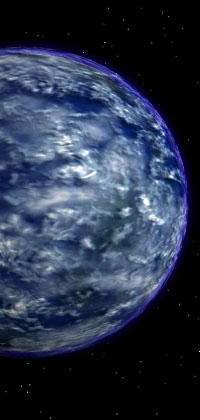


Andor is a beautiful blue green planet that circles the orange dwarf star Epsilon Indi. Slightly larger than Terra, it is a Class M world and home of the well known race of white haired, blue skinned, antennaed humanoids called Andorians. Andor is one of the five founding members of the United Federation of Planets, and therefore holds a permanent seat on the Federation Council. The current population of Andor is approximately 4.1 billion inhabitants.Andor is the fourth of eight planets in the Epsilon Indi system and has three natural satellites, named Dem. Calk 1, and Calk 2. Dem is a barren ball of rock slightly smaller than Terra's Luna, and Calk 1 and Calk 2, known as the Twins, are small asteroid like rocks that orbit one another while orbiting Andor. Calk 1 is 1,467 miles in diameter and Calk 2 is 521 miles in diameter. The distance between Andor and the Twins is slowly increasing, and it is estimated that they will break free of Andor's gravity within the next millennium. Careful study of this eventuality has indicated that this change will cause no harm to Andor due to the small size of the asteroids. The diameter of Andor is 10,468 miles, and has an equatorial circumference of 35,517 miles. The surface of the planet is covered by 47% water, making Andor one of the largest water-to-land ratio Class M inhabited worlds in the Federation. Andor has a total surface area of 344.2
million square miles, which is comprised of 182.4 million square miles of land and 161.7 million square miles of water. Andor revolves around Epsilon Indi at a mean distance of 1.37 A.U.s (127.4 million miles), and completes one orbit in 500.39 Terran days. Andor has a gravity of 1.29 and rotates on its axis-once-every 21 hours 25 minutes. The atmosphere of the planet is thinner than the atmosphere of Terra, usually 590 mm of mercury at sea level, compared to Terra's 760 mm.Andor is comprised of four major land masses and several smaller islands. The largest land mass, called Mangea, is the southern continent and makes up 48% of the total land mass, or 87.5 million square miles. The second largest land mass, called P'lith, adds another 32%, or 58.3 million square miles. Two large continent sized islands, called Calith and Dor, add another 18% (32.8 million square miles, and the remaining 2% (3.6 million square miles) is made up of several small islands.
The Andorian oceans contain many of the same elements found in Terra's oceans, but has very little salt. However, there is a chemical which is abundantly produced by one of Andor's marine species which can make the water taste and smell very unpleasant to many non-Andorian races, including Humans. (It has been likened to the strong and malodorous taste and smell of Artesian water found on Terra, only much more potent.) When threatened, this fish, known as a gompa, ejects a chemical from a gland behind its anus which will usually make its attacker flee. Because of this ability, gompas have few natural enemies and have flourished in the Andorian seas. Gompas, which have been known to swim in schools of several billion fish, can simultaneously release this chemical when danger is sensed. Once one fish releases the chemical, other fish nearby will release their chemical automatically, without even having to sense the danger itself. Although the chemical is harmless and dissipates after a short time it can make Humans ill from the overpowering effect if the discharge is from a large school. Fortunately, gompas prefer deep water and seldom approach close to shore.Like many of the Federation's advanced civilizations, Andor has installed weather management systems which give the planet a mean temperatures of 64 degrees Fahrenheit at the equator to -23 degrees Fahrenheit at the poles. Andor once had small ice caps at the poles, but these were slowly melted once the weather management system was installed. The Andorians had to give up approximately 1.2 million square miles of coastal territory as the ice caps melted and the sea rose about 2" overall, but they felt this was a fair trade-off in order to make the southern continent totally habitable. Despite dire warnings from some Andorian scientists, the temperature rose an average of only 4 degrees
Fahrenheit without the ice to cool the planet and reflect sunlight.The Andorians are the least technologically sophisticated race to join the Federation. Andorians are one of the few civilizations to have developed warp drive on their own. Before they had encountered their first Human, they
had established the Andorian Star Clan, formed by each clan contributing some of their best engineers and scientists. This clan, which developed Andor's fledgling space program and began exploring their solar system, eventually went on to acquire an empire of thirteen planets. First contact with Humans in 2118 did not go well, and ended with an Andorian ship opening fire on a Terran exploratory vehicle, killing its four man crew. Luckily, before either side could gear up for war, they each received a peace delegation from Vulcan, a race that both the Andorians and the Humans had encountered several years previously. As the Andorians themselves were creatures of logic, the Vulcans were
well received and war was averted. Fesoa, their home world, was just entering the space age when they were attacked and conquered by the Romulans. Fesoa, rich in valuable metals, was a perfect place to serve as a military supply base and troop garrison. The Romulans captured and exterminated whole cities and turned them into military industrial complexes. As for most of the races in that area of the galaxy, the Romulans never allowed their faces to be seen by the Andorians. There was no organized government on Fesoa for the years of occupation but their were many resistance groups. Andorian scientists would often back engineer stolen Romulan hardware. In this way, the Andorians taught themselves how to fight back. Finally, Earth forces came and liberated the planet. Over the course of the war, the Andorians did everything they could to aid their liberators. In the last year of the war Andorians, supervised by human engineers, built attack vessels that significantly aided in the final defeat of the Romulans. Andor eventually went on to join a loose alliance of Terran, Vulcan, and Alpha Centauran merchants. Several years later, with the admission of Tellar as the fifth member of this alliance, the necessity for a stronger military alliance was realized.
Much that appears bizarre and bewildering about Andorian culture - its violence, territoriality, demanding etiquette, clan based social structure, contradictory sexual morality, oddly primitive religion and art, grim practicality and tendency toward fratricide - becomes comprehensible when one learns the nature of Andorian biology. Andorian culture appears to be shaped almost entirely by biology, and attempts to reach beyond biology meet with only partial success.The Andorian race is believed to have originated in the glaciers and ice fields that once covered the southern continent. Because of this development, Andorians are to a degree endothermic and have trouble keeping their body temperatures at their normal 57 degrees Fahrenheit when the outside temperature is above 80 degrees Fahrenheit. Exposure to temperatures above 100 degrees Fahrenheit for prolonged periods can cause an Andorian to abandon their logical thought processes and become cunningly violent.
Andorians are a comparatively tall species, averaging between 1.7 and 2.1 meters in height. Although obesity is not unknown, it is culturally condemned and most Andorians are quite slender for their height. This often gives them a misleading appearance of fragility, which is belied by their remarkable physical strength. Due to the extreme density of bone and muscle tissue, the average Andorian is quite capable of lifting an object of twice his or her weight.
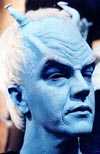
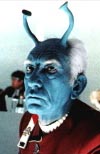
The most remarkable of the Andorian physical features are the antennae, which are set slightly higher on the head than ears on a human. These are highly sensitive, semi rigid structures of muscle and cartilage, their tips containing directional hearing organs, the long-distance heat sensing organs and the telepathic sensors which play an important part in the reproductive cycle. The antennae also express emotion, far more than do the facial muscles, and are the prime indicators of Andorian body language. They express polite interest by curving toward the object of attention, fear or excitement by standing rigid and quivering, weariness or depression by drooping, confusion or upset by wringing and lashing, sexual arousal by slow writhing, intoxication by wobbling unsteadily in different directions, and rage by pressing back against the skull. Andorians "kiss" by touching the tips of their antennae together.
Because of the importance of the antennae, much of Andorian psychology revolves around these organs. Fear of damage to the antennae is deeper and more widespread than castration anxiety in humans. Loss of antennae to an Andorian is the equivalent of deafness, muteness, castration and mutilation of the face to a human, and no Andorian will voluntarily survive such an injury.
Subsequently, the uninvited touching of the antennae is considered an unpardonable rudeness, and the threat of injury to antennae is legitimate grounds for assault and murder - as occasional, unfortunate incidents have shown.
Because of the telepathic organs and their relation to the reproductive process, the antennae are also considered proper sites for valuable jewelry, particularly gifts from friends, lovers and mates. The Andorian version of the wedding ring is worn on the left antenna rather than on a finger. To give an Andorian antenna rings or antenna bells is to make a gesture of great friendship, if not of courtship.The Andorian social structure is characterized by extended families, which consist of at least four individuals in a matrimonial relationship, and tribes, which roughly correspond to the Klingon houses. The Andorians regard themselves as a passionate, aggressive, even violent species, however, their character is much more complex. At first glance, the intelligent, apparently intellectual humanoids give the impression of being deadpan and emotionless, very calm, rational and logical like the Vulcans, but different from them, their indeed existing emotions can emerge with intense psychological and physical reactions. Andorians live for about 180 years. they are egg hatched and their incubation lasts 11 months.
Their known irritability is caused by the ambient temperature : when it raises over 30°C the andorian body produces an enzyme making them easily irritable. This is one of the reasons for their cities to be built underground. Even though the Andorians also stand out due to their great strength and agility, they are not regarded as an exclusive race of warriors, since they usually exert violence only if there aren't any other possibilities, and even then they act controlled and rationally. The purpose, the pursued profit is important, not the act of violence itself, even if the motif is greed or jealousy.
Andorian currency is based on the value of livestock. The largest denomination is the teeghar, the largest domestic animal, roughly equivalent to the Terran horse or cow. Smaller denominations include the sleemhar roughly value of a domesticated reindeer, the nohagar value of a large pig, the ashklar a value of an antelope, and the mefilhar the value of a small goat.With the advent of space travel, Andorians began to think seriously of themselves as a species rather than a collection of clans. The discovery of semi intelligent life on the fifth planet of their Epsilon Indi system compelled Andorians to consider the existence of other intelligent species and the possibility of interplanetary warfare. This led, by analogy, to the concept of all Andorians as members of one super clan, faced off against other such super clans. The immediate result of such thinking was that a planetary government consisting of a council of elders, one from each major clan, became feasible. Thus did Andor jump from a fragmented, clan based society to a fairly unified, planetary society - without going through the stage of nationalism. This unique case of rapid social evolution proved remarkably successful for the Andorians, although it did cause some problems with early contacts between the Andorian Empire and the other Federation co-founders of Earth, Alpha Centauri, Vulcan, Tellar.
Indeed, one may say that successful relations between Andor and Earth were the result of the famous Andorian practicality. Despite those lamentable early misunderstandings, the Andorians soon realized that membership in a multi-stellar community held great advantages for them - particularly in technological gains, such as reliable methods of birth control and faster-than-light space drive. FTL drive especially, with its concomitant possibility of interstellar colonization, may prove to be the greatest scientific advance in Andorian history - freeing the Andorians from their age old problem of too much population on too little land. This fact alone would explain the presence of so many Andorian neuters flooding Starfleet Academy and, indeed, all Federation space lines, with applications in a desperate attempt to get out into deep space.
Whether or not these escape attempts will be successful in reducing Andorian population pressure, and whether or not such success will reduce the aggressive tendencies of Andorian nature, is still unknown. Nonetheless, there is much reason to hope that, in time, we shall no longer agree with the famous comment by the lone survivor of the first contact team: "Aliens? Migod, what aliens! These people are so alien that, compared to them, the Vulcans might as well be from New Jersey!"